People: MinSeob Lee from Diagnomics
  [2012-06-01]

Two patients with the same diagnosed cancer type might have two completely different therapeutic outcomes after applying the same treatment regimens: one with good results, the other one with no effective or negative results combined with a variety of treatment-specific side effects. This is due to the fact that genomes of these two cancers are quite different. It has been shown that if one can distinguish positive responders from negative ones solely by analyzing their genes, patients can avoid unnecessary treatments and vastly enhance desired treatment effects and which in turn leads to increased survival rates.

Personal genomic information will ring in a new era of medicine in the not too distant future. This industry sector is currently growing rapidly (more than doubling per year) and did not even exist just five years ago.

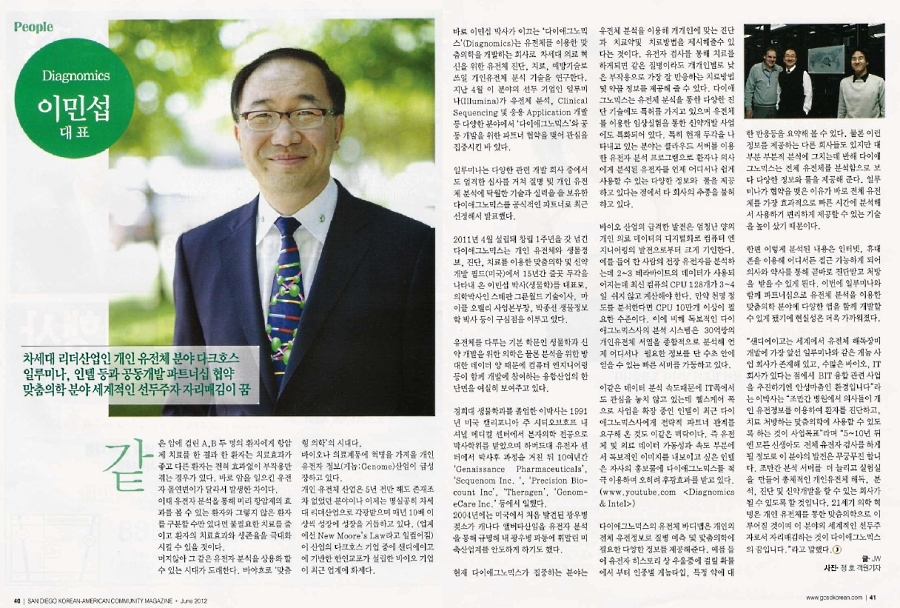
One of the recent startups in this sector is Diagnomics, a company founded by Dr. Min Seob Lee, a Korean immigrant to the United States. Diagnomics provides genome annotations that aim for the personalized medicines. Diagnomics also collaborates with Illumina, the leader of this industry, to develop a variety of clinically useful applications. Among several companies that specialize in this field of disease and personal genomic analysis, Illumina specially chose Diagnomics as one of their partners (see Illumina press release).

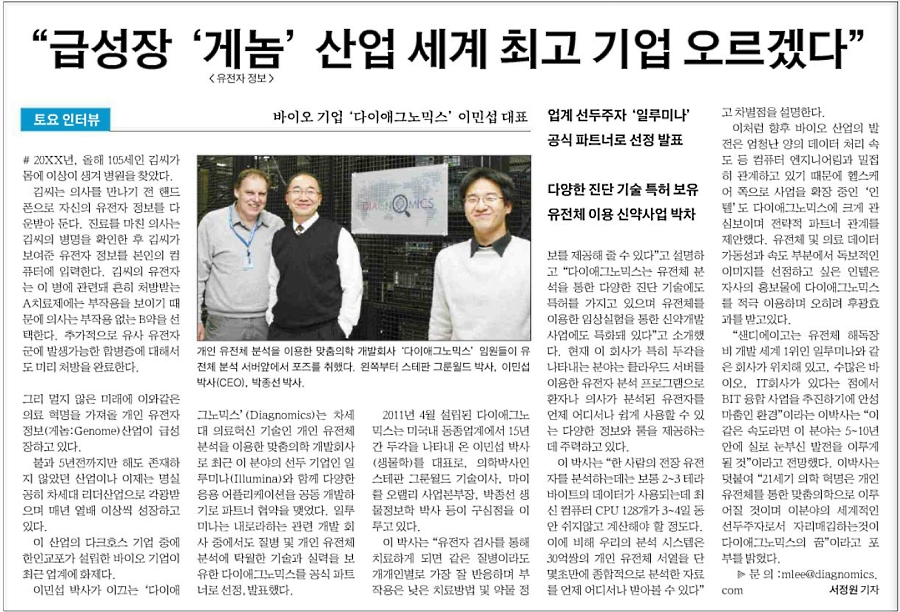
Diagnomics was founded in April 2011 by Dr. Min Seob Lee, former CEO and Dr. Stefan Grenwald, former CTO. Currently, Michael O'Reilly acts as VP of Business Develeopment and Dr. Jongsun Park assumes the role as Bioinformatics Group Leader. Both are core members of the company.

Dr. Lee graduated from KyungHee University in Korea with a BS degree in Biology. He received his Ph.D. from the City of Hope National Medical Center in California in 1991. He then moved to the Genome Center at Harvard University for post-doctoral training. Additionally, he has over 10 years experience in the biotech industry where he worked at Genaissance Pharmaceuticals, Sequenom, Precision Biocount, Theragen and GenomeCare. He discovered that the first mad cow disease in the States originated from Alberta, Canada.

Dr. Lee states: "If patients are treated based on their own genome information, medications with the smallest possible side effects can be chosen and the best responses will result." He also mentions that Diagnomics works on several patents related to genome analysis and diagnosis. With this foundation, Diagnomics will be able to develop new personalized medicines. Diagnomics is using a special cloud server to utilize its annotation systems, so physicians can access patient information from anywhere in the world.

He also explains that in order to analyze a person's genome, it takes around 2-3 Terabytes of information, and one needs 128 CPUs to run for 3-4 days to crunch the necessary data. Diagnomics' system allows 3 billion personal genome datapoints and its analysis to be downloaded in the matter of seconds in anywhere, anytime.

The genome body map Diagnomics' software suite creates provides various information that is needed for disease identification and personalized medicine development. As an example, based on the genomics, the probability of developing a certain disease, genome typing based on ethnicity, drug responses and much, much more are being shown in a special report provided by Diagnomics. There are many competitors in the field that provide a similar service, but they are usually limited to a certain area. Diagnomics analyzes the whole genome in order to provide a more diverse kind of information and tools. The reason why Illumina selected Diagnomics is its ability of analyzing the whole genome in the most effective way within a minimal amount of time.

The biotech industry of the future will require big data and computer engineering related work to handle the huge amount of data to be stored and analyzed.Thus, Intel, which is expanding their business into the healthcare field, has shown big interest in working with Diagnomics and has signed an NDA. Intel now tries to solidify their commitment in the field of genomics and medical data analysis by working with Diagnomics on a white paper.

San Diego is the leading city for biotechnology business, partially due to the fact that the Illumina headquarter is located here. San Diego also hosts over 300 biotech companies of all sizes. The field of genomics will show the fastest growth with many successful results. Dr. Min Seob Lee has a big vision for the medical revolution of the 21stcentury, which will depend on personalized medicine and personal genomics, and the ultimate goal for Diagnomics is to become a leader in the field of personalized medicine.
New company: A rapid growing genome industry
  [2012-05-05]

Year 20xx, a 105 year old patient is visiting a doctor's office. Before the appointment, he downloads his genome information to his phone. After the visit, the doctor gets the patient's genomic information handed over together with its correlated disease diagnosis. Instead of prescribing medicine A that is usually prescribed, the doctor prescribes medicine B since the patient is allergic to A, and possible side-effects are prevented as well.

Personal genomic information will ring in a new era of medicine in the not too distant future. This industry sector is currently growing rapidly (more than doubling per year) and did not even exist just five years ago.

One of the recent startups in this sector is Diagnomics, a company founded by Dr. Min Seob Lee, a Korean immigrant to the United States. Diagnomics provides genome annotations that aim for the personalized medicines. Diagnomics also collaborates with Illumina, the leader of this industry, to develop a variety of clinically useful applications. Among several companies that specialize in this field of disease and personal genomic analysis, Illumina specially chose Diagnomics as one of their partners (see Illumina press release).

Diagnomics was founded in April 2011 by Dr. Min Seob Lee, former CEO and Dr. Stefan Grenwald, former CTO. Currently, Michael O'Reilly acts as VP of Business Develeopment and Dr. Jongsun Park assumes the role as Bioinformatics Group Leader. Both are core members of the company.

Dr. Lee graduated from KyungHee University in Korea with a BS degree in Biology. He received his Ph.D. from the City of Hope National Medical Center in California in 1991. He then moved to the Genome Center at Harvard University for post-doctoral training. Additionally, he has over 10 years experience in the biotech industry where he worked at Genaissance Pharmaceuticals, Sequenom, Precision Biocount, Theragen and GenomeCare. He discovered that the first mad cow disease in the States originated from Alberta, Canada.

Dr. Lee states: "If patients are treated based on their own genome information, medications with the smallest possible side effects can be chosen and the best responses will result." He also mentions that Diagnomics works on several patents related to genome analysis and diagnosis. With this foundation, Diagnomics will be able to develop new personalized medicines. Diagnomics is using a special cloud server to utilize its annotation systems, so physicians can access patient information from anywhere in the world.

He also explains that in order to analyze a person's genome, it takes around 2-3 Terabytes of information, and one needs 128 CPUs to run for 3-4 days to crunch the necessary data. Diagnomics' system allows 3 billion personal genome datapoints and its analysis to be downloaded in the matter of seconds in anywhere, anytime.

The genome body map Diagnomics' software suite creates provides various information that is needed for disease identification and personalized medicine development. As an example, based on the genomics, the probability of developing a certain disease, genome typing based on ethnicity, drug responses and much, much more are being shown in a special report provided by Diagnomics. There are many competitors in the field that provide a similar service, but they are usually limited to a certain area. Diagnomics analyzes the whole genome in order to provide a more diverse kind of information and tools. The reason why Illumina selected Diagnomics is its ability of analyzing the whole genome in the most effective way within a minimal amount of time.

The biotech industry of the future will require big data and computer engineering related work to handle the huge amount of data to be stored and analyzed.Thus, Intel, which is expanding their business into the healthcare field, has shown big interest in working with Diagnomics and has signed an NDA. Intel now tries to solidify their commitment in the field of genomics and medical data analysis by working with Diagnomics on a white paper.

San Diego is the leading city for biotechnology business, partially due to the fact that the Illumina headquarter is located here. San Diego also hosts over 300 biotech companies of all sizes. The field of genomics will show the fastest growth with many successful results. Dr. Min Seob Lee has a big vision for the medical revolution of the 21stcentury, which will depend on personalized medicine and personal genomics, and the ultimate goal for Diagnomics is to become a leader in the field of personalized medicine.


OncoDNA Inks Exclusive Distribution Agreement for South Korea
  [2015-07-16]

NEW YORK(GenomeWeb) - OncoDNA announced on Wednesday that it has finalized a South Korean distribution agreement with Eone-Diagnomics Genome Center (EDGC)

Under the terms of the agreement, EDGC will have exclusive distribution rights in South Korea for the OncoDEEP Dx panel and other cancer-related tests. Korean physicians will have access to clinically relevant interpretations of test results using the OncoShare web platform.

The OncoDEEP Dx is a 50-gene next-generation sequencing-based diagnostic test that runs on Life Technologies' Ion Torrent instrument.

EDGC offers a range of products and services for personalized medicine based on NGS and other genomic technology. The firm is a joint venture established in 2013 by the Eone Life Science Institute in South Korea and Diagnomics in the US.

Last week, Belgium-based OncoDNA signed a distribution deal for Israel with Progenetics. The firm said it now has 15 exclusive distribution deals.

Press Release 4
Press Release 5
Press Release 6